Herding by hand
Sheepdogs began with a dog under your cursor. Over the last few weeks the dog went away, the cursor became a hand, and herding became drawing. This is how that happened, with the studies we played along the way. The small arena at the end is now the game at sheepdogs.io, and the version with dogs is still there at sheepdogs.io/legacy. The scenes are live: move over one to take the hand.
By Ege · 1 November 2026
The hand on its own. It presses on the grass to move a few sheep, picks one up and holds it until it falls asleep, sets it down, pats the grass, and throws another. Press on a sheep to pick it up yourself.
A hand instead of a dog
In the first Sheepdogs your cursor was a sheepdog. You pointed, the dog ran there, and the sheep moved away from it, with up to a thousand people herding on one map. It worked, but the dog always trailed behind the pointer, and in a browser the best thing to play with is the cursor, which goes exactly where you point.
So the cursor became a hand. A hand can do what a dog can't. It picks a sheep up, carries it, throws it into the fold, or strokes it until it sleeps. It also meets other people's hands, and can bump them or slap them.
How it looks
We tried five looks for the hand and the field and kept two: gouache, with grass in dabs of two greens and a knitted cuff on every hand, and clay and felt. The hand is built in the browser from simple rounded shapes: a palm, a heel, four fingers of three joints each, and a thumb. The first thumb started too high and read as a little finger stuck to a pad, so it moved down to start near the wrist, where a thumb does. The arm hangs from an elbow that trails behind the hand, so when the hand swings sideways the arm angles back along the way it came.
Picking up and throwing
The pick-up follows how people who handle lambs describe it: come in low from the side, slide under the chest and hindquarters, lift level and keep the lamb close. Setting it down is the same in reverse; the hand lowers, tilts, and the lamb steps off. A throw is a flick. People slow down just before they let go, so the throw reads the fastest stretch of the last eighth of a second, and a quick flick throws even if the hand has nearly stopped.
Press on a sheep to lift it, and drag to carry it. Let go still to set it down, or mid-swing to throw it; the ring on the grass shows where it will land.
One button
Everything you do is one button. What's under the hand when you press decides what happens, so there is never a tool to choose.
On a sheep. The hand picks it up. Let go still to set it down, or mid-swing to throw it.On the grass. The finger draws. A line that comes back round some sheep closes into your ring. A quick tap calls loose sheep over.In your ring. The finger draws their way. They trot along it and stop where it ends.On someone else’s ring. The finger paints over it. When the whole ring is your colour, the flock is yours.
Herding, three times
Herding itself took the longest. We rebuilt it three times. Each version had a simple script that played it by itself, which told us roughly how fast a flock of fourteen could be penned.
The palm as a dog
The first hand kept the dog's job. Press on the grass and the palm pushed the sheep the way a dog's presence did. It worked, and it was dull. The palm trailed the pointer at a dog's pace, the sheep walked at 1.2 m/s, and the push was soft and invisible, so most of the time you were waiting.
Sweep and flow
The second version made the palm work like a broom. Sheep in front of a moving palm are carried along, sheep beside it step aside, and sheep behind it are left alone. Drag round a flock and everyone is pushed toward the middle, so it bunches up. The flock kept together, glided on after a stroke, and the gate drew in the sheep that reached it. It was much faster, but sweeping a flock all the way home was work, because your hand had to stay with the sheep the whole way.
Draw the way
The third version gives a bunch of sheep somewhere to go, and they go there while you do something else. Draw a circle round some sheep and they gather inside it, in a ring of your paint. Draw a line out of the ring and they trot along it, while you go and circle the next bunch. A line holds a set amount of paint, so a circle can only be so big, and a tap on the grass gathers stragglers into a bunch small enough to circle.
In the pen: 0 of 14
The same field herded three ways. Left alone, each plays itself; the script pens the flock in about 31 s with the palm as a dog, 13 s with sweep and flow, and 11 s by drawing. Move over the field to take the hand: press on the grass and drag.
With other people
Drawing worked well alone, and other players broke it. If a line can reach the fold from anywhere, you circle a flock, draw one long line, and you're done; nothing can happen to the flock on its way unless someone circles it. So lines got short.
A flock's trip home. A line holds a few metres of paint. At its end the flock waits in its ring, drifting slowly toward the fold, until you draw the next line. On the trodden grass round the fold it walks onto the straw by itself.
Short lines mean visits. You keep two or three flocks going at once, and any flock you leave waiting is open to everyone else. Taking it has to be something you can see coming and answer, so it works with paint: a flock in someone's ring stays theirs until the ring is painted over in another colour.
A split ring stands still. While a ring has two colours its flock stops. If it stays split for three seconds, the sheep walk out loose.Unfinished paint dries back. Paint that doesn’t go all the way round turns back to the owner’s colour within two seconds.A slap stops a painter. A hand arriving fast knocks the painting finger off the grass, and its paint smears off the ring.The trodden grass is safe. Near the fold nobody can take a flock, and a circled flock walks in by itself.
Hands have bodies too. Hands that touch push each other aside, and a hand that arrives fast slaps. A slap only stops a hand that is up to something, drawing or carrying, so nobody can use it to pester someone who is only looking around, and a slapped hand can't be slapped again for a moment and a half.
The fold in the middle is open all round: a circle of straw ringed by small stones. We had four gates at first, but they only made flocks walk the long way round, and flocks arriving from every side make a better scene.
Four hands in one field: you in raddle red; Woad, who only herds; Weld, who takes small flocks whose owners are busy; and Madder, who sometimes does. A ring that flashes is being painted over. Slap the hand doing it, or go round your ring to paint it back.
A small arena
To find out whether this is fun with people, we built it as a small game of its own first, for 8 to 16 players, before changing the main map. The rules run in Rust on the server and, compiled to WebAssembly, in your browser when you play alone against bots. A tick takes 0.04 ms with eight players, and each player receives about 180 kbps.
The bots try to play like people. They only notice what's on their own screen, take between a third and two thirds of a second to react, draw circles that wobble and sometimes don't close, and keep no more than two or three flocks going. While we play, a panel changes about twenty numbers for everyone, from how much paint a line holds to how fast a slap has to be. After each round a report shows what everyone did: circles closed, lines drawn, the wait between lines, sheep taken and lost, and slaps.
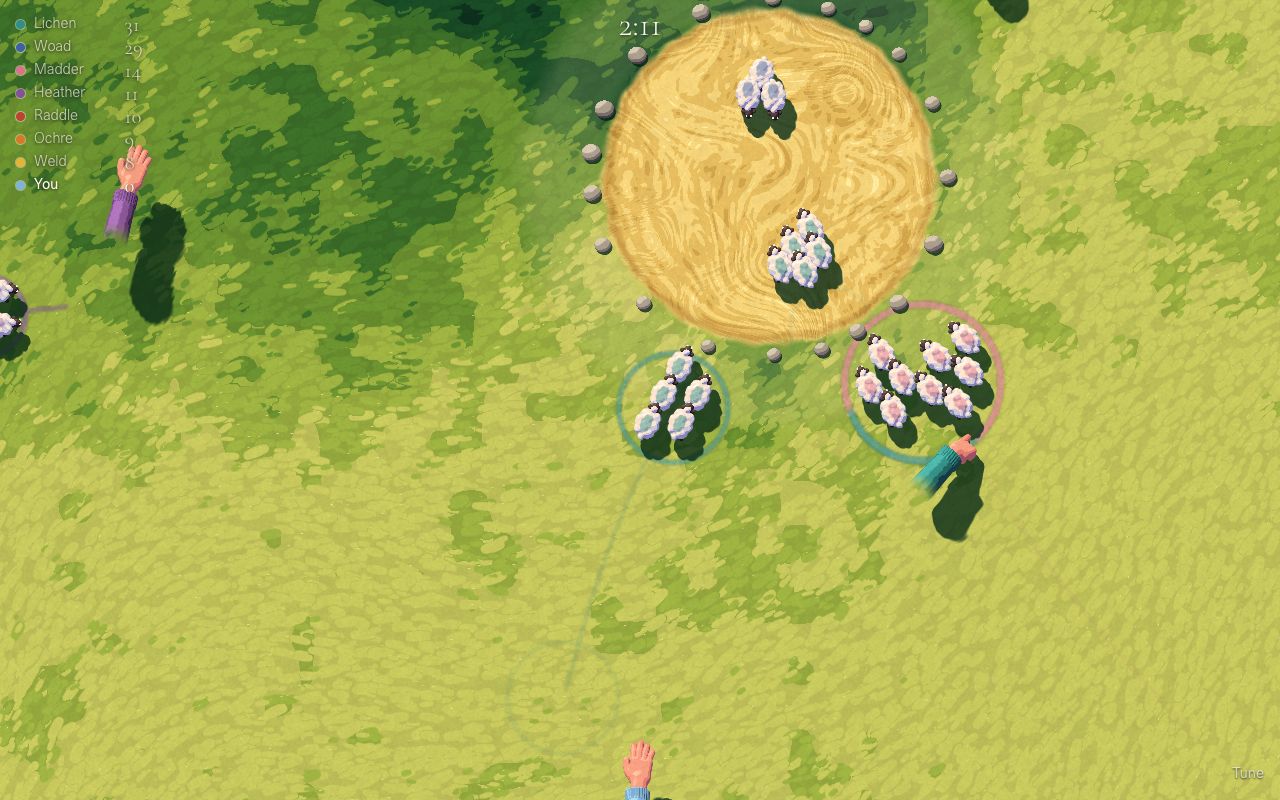 The arena in the game. The studies drew every pixel by testing it against each sheep, which is fine for fourteen sheep and too slow for a crowd, so the game draws each sheep and hand on its own small patch of the screen. A frame takes 3 to 5 ms with a few hundred sheep in view.
What comes next
Next is playing it with people, and since 1 November anyone can, at sheepdogs.io: you join a room of eight, and bots take the places nobody is in. After that, there are a few ideas we want to try. A finger could draw gates and fences that last a little while, to funnel your sheep or block someone else's. A high five over a ring two people are fighting for could share the flock between them. A finger could draw a small rain cloud over a patch of meadow. And on phones your finger is your hand, so you see everyone's hand except your own.